
Terrible Clear Weather
On losing friends to Cholangiocarcinoma, and what stays visible when the fog is gone

2026 is only half over, and already it is defined by the friends I have lost to Cholangiocarcinoma.
Cancer friendships are not like other friendships. There is no need for small talk. You already know too much.
You know the wait for scan results. You know the word stable, the word progression, what each one does to the body. You know the waiting room, the book open in your lap, no idea what the page says. You have grieved your own death and your own life, your relationships, the person you were, before.
The closeness comes quickly because the worst things are already in the room. So you talk. By the time the first tea or Diet Dr. Pepper is finished, you have said things to each other that other friends spend decades circling.
The strange part is going back out into the world afterward, to dinner parties and work calls. You come home from an infusion suite where you discussed sex, death, funeral music, a graduation you may not see, and someone asks how your weekend was. You are bilingual now.
Nina Riggs was thirty-nine and dying of metastatic breast cancer when she wrote The Bright Hour. Near its end she passes along an image a cousin gave her. Living with a terminal disease is like walking a tightrope over what she calls an "insanely scary abyss." Living without disease is the same tightrope over the same abyss, only with fog obscuring the depths.
What the fog softens is not the danger. What it softens is the seeing: the nearness of the drop, the fact that the rope is all there is. The healthy walk the same wire we do. They just get weather that lets them forget. Some days, when the fog thins, they glimpse what's underneath: a friend's diagnosis, a near miss on the highway.
Then, mercifully, the fog rolls back in, and they go on renovating kitchens.
For those of us with metastatic cancer, the fog burned off the morning of diagnosis and never returned. We walk in terrible clear weather. We can see exactly how far down the abyss reaches, and exactly how thin the rope is.
When you are with someone else who also sees the drop, there is nothing to hide behind, and no need to hide.
The drop gives you something else: a kind of freedom. Once you have looked all the way down, you stop caring about the rest. Not carelessness. Discernment. The bullshit falls away first, then the performing, then the opinions of people who were never walking your rope anyway. What’s left is short and true: this person, this afternoon, this work, this love. We travel light because we must.
This year I have watched too many extraordinary people disappear.
Strong. Funny. Brilliant. People call them warriors, fighters. I understand why. I have used those words too. But they were not superheroes. They were human. Which is harder and better.
Cancer does not usually take people all at once. It erodes them. Piece by piece. Energy first, then appetite, then weight. Then distances: the walk to the corner, then the stairs, then the hallway. Then independence, which sounds abstract until it is someone holding the cup. Then plans, which hope defends the longest. Then voice.
The fall is the moment the warrior narrative wants: a single dramatic ending, a last battle, a drop from the wire. The truth is more brutal because it is more prosaic. Most of my friends did not fall. They were worn away while still standing on the rope, and the wearing took months, and everyone who loved them had to watch.
I watched them meet the disease with everything they had. I watched it take things anyway.
The dying is not the cruelest part. The stripping away is.
Except once. One of them was almost entirely himself to the end. His hospital room was the rowdiest room on the floor: a crowd of his friends, and him in the middle of it, introducing us to each other, making sure everyone was happy, offering advice, offering connections. It felt nothing like a room someone was dying in. The day before he died, deep into jaundice, he was still texting jokes: They call me Mello Yello. A few hours from the end, he sang Happy Birthday to another of our friends.
I keep wanting to call that a mercy. For him, maybe it was. For the people who loved him it was almost crueler. The long erosion is terrible but honest: it lets you begin grieving while the person is still there. His family got him whole. They got to keep believing. And then the wire simply ended.
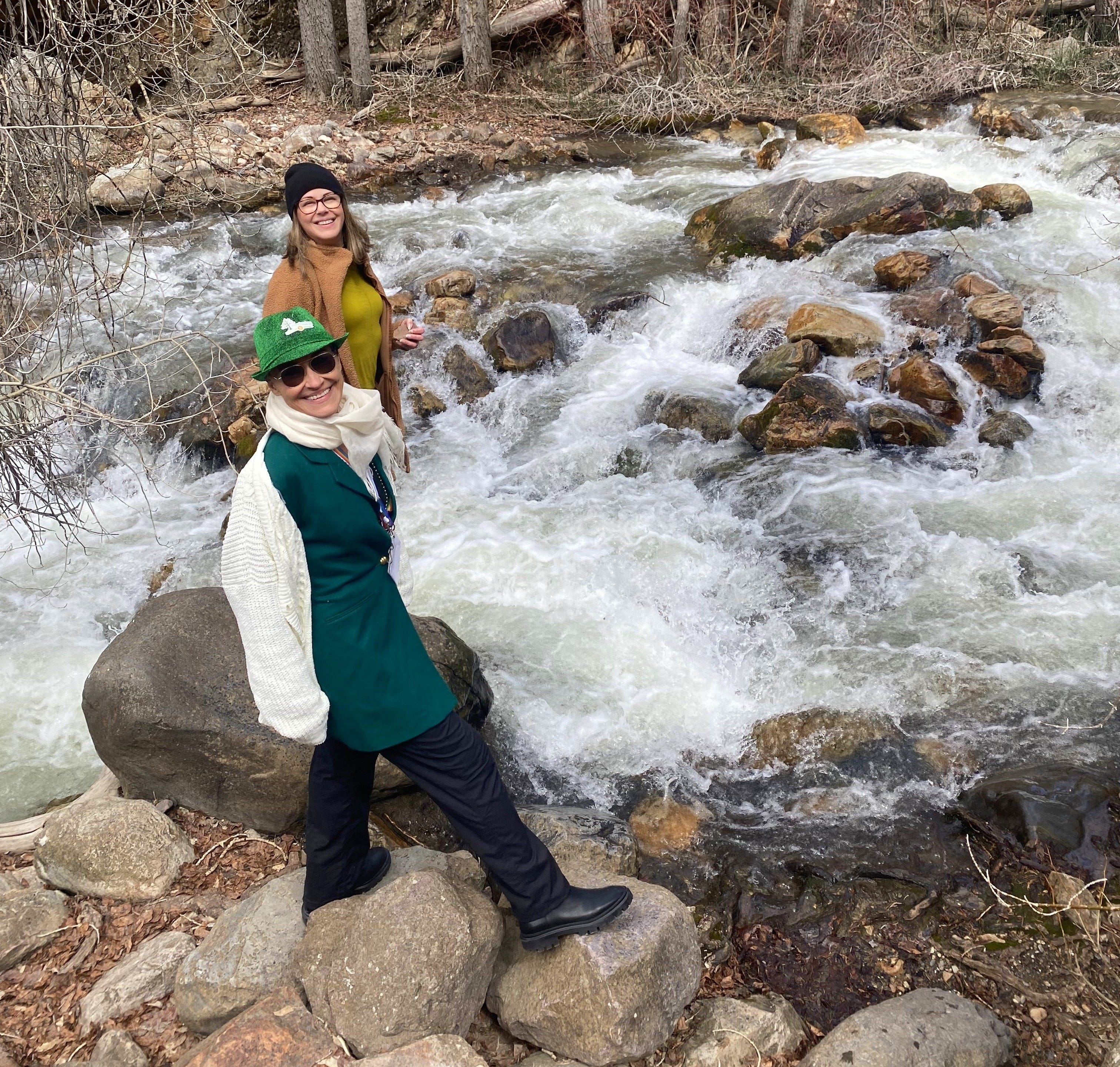
Another death this year: a soul friend. Once, at the annual Cholangiocarcinoma Foundation Conference in Utah, we slipped away and ended up at a mountain stream. I don’t remember whose idea it was. She knelt at the edge and I cupped the freezing water in my hands and poured it over her bald head. She gasped. Then she laughed. Then she did the same for me. We called it a baptism, half joking, and then not joking at all: two women the treatments had stripped bare, anointing each other with snowmelt.
So of course we planned the other thing too: whoever went first, the other would be at her deathbed. We talked about it plainly, practically, the way you might plan a trip. It was not morbid. It was one of the most loving conversations of my life. The plan was a small architecture of love, built for a future we knew one of us wouldn’t see.
The plan assumed dying would be slow enough to see coming. She died quickly, far quicker than I had imagined. No bedside, no vigil, no keeping the promise.
I was standing in the kitchen when the text came in. I remember the counter under my hand, the light in the room, and that I had been doing something ordinary, though I couldn’t tell you what. I read the message once, then again, as if repetition might make it less true.
Then I folded.
My body simply gave out under the weight. I went down to the floor because there was nowhere else to put it. The afternoon kept existing around me. The sink. The mail. The kettle. All of it still there. She was not.
Here is what I keep turning over: her death was not incomplete. I have come to believe that dying keeps its own time, and that the time is right for the one who goes, even when it arrives sideways to everyone else’s plans. She didn’t need me at the rail to cross. The incompleteness lives only in me: the unwitnessed crossing, the promise still standing in an empty room. What remains is love with nowhere left to go.
Since I was diagnosed, loss has been the weather. First a storm, then a season, then simply the climate.
You learn early that the person helping you decode your first scan may not be here for your third.
I thought I had made my peace with that arithmetic. This year taught me I haven’t.
This year, the losses are people I have known for years. People I was in communion with long enough that we became part of each other’s lives. The ones who understood every scan, every CA 19-9 result, every miracle and every disappointment without needing a single word of translation. Friends who were still here, after so many others were gone.
Many were younger than me. One has children who still call for her in the morning.
Another friend is in the hospital right now.
I am waiting. Watching. My heart sinks when I don't hear from her. It sinks again when I do: some new complication, some new thing taken.
She has lived less than half the life I have been given. It is out of order. I keep thinking about everything she should still have: years that belong to her, ordinary days to waste, complain about, take for granted.
There is a name for what I am doing, though I resist it: anticipatory grief. Mourning someone who is still here, still texting, still making the nurses laugh. It feels like a betrayal. As if my sorrow might reach her room before the outcome is decided, as if grieving early gives death a vote it hasn’t earned.
Of all people, she could rally. People in our community rally all the time. I am myself an improbability, five years past a prognosis that gave me far less. So I hold both: the phone I can’t stop checking, and the stubborn hope that this vigil is premature. I have been wrong about death before. I am asking it to make me wrong again.
The griefs don’t take turns. They stack.
I don’t know what to do with being the one still here.
Every time someone dies, the question comes back. Why them? Why not me? I have the same disease, similar scans, the same odds. I did not fight harder than them. I did not want to live more.
And yet I am still here, writing about them. Turning people I loved into sentences they will never read.
I cannot make it make sense.
People imagine metastatic cancer as one long battle with your own body. But so much of it is mourning other people.
Here is what surprises me. I am not especially afraid of my own death. I have done that work: the nights of looking straight at it, the rehearsals, the slow befriending of the mystery. What no one prepares you for is that the peace doesn’t transfer. Their deaths take everything out of me that mine no longer does.
My circle of cancer friends keeps shrinking. Every loss changes the shape of the room we are all still standing in.
Cancer doesn’t just threaten your own life. If you live long enough, it asks something harder of you: to outlive your teachers. The people who showed me how to read a scan report, how to ask for a second opinion, how to laugh in an infusion chair. They built the survival I am now using. Almost every skill I have for enduring this was a gift from someone who is gone.
That is the weight of this year. Not one loss but many, each one entire. And underneath them all, the fact that I am still here, and they are not.
After it burns off, the fog never comes back.
Once you’ve lived here, once you’ve loved these people, once you’ve watched them disappear, you cannot unknow what you’ve seen from the rope.
But there is a strange gift in the clear weather, and I say this carefully, because today I am not in the mood for silver linings. My phone is face-up beside me as I write, and I am still waiting for news of my friend in her hospital bed.
The gift is this: because everything is so visible, the love is visible too.
I keep returning to that mountain stream. I could not keep my promise. I was not there when she crossed. But I was there, once, kneeling in the cold water with my hands full of it, and she was laughing. Whatever I failed to witness at the end, I witnessed that.
Only love. That’s what’s left when the fog clears.
Thank you for reading. Today's essay is free for everyone. If it stays with you, consider sharing it with someone who might need it, or becoming a paid subscriber. A click of the ♡ helps too.
Stephanie,
I found your posts shortly after my husband Chris was diagnosed with CF.
I immediately felt like, I want to meet this Stephanie, her words are salve to my being. Also, I soon learned that patients and caregivers can not know each other's path and grief.
Your post today on living with a clear view of the abyss touches me, especially because Chris and I are both rock climbers. For decades, we have trained our bodies and minds to think clearly and distinguish between fear and actual danger. Yet, it seems that the clear seeing that you descibe touches the wisdom of not-knowing. A clear view of the abyss and not knowing when we or our dear friends will fall.
I feel my body take a breath in and a deep release. I appreciate all that you are passing on to us.
In gratitude, Sarah
No less than your strength through adversity, Stephanie, your ability to convey such beautifully written words and tributes to others are astounding! Stay as strong as you can for as long as you can - as always with love and with you in spirit, M xx