
No There There: Notes on Planning My Death

Green-Wood Cemetery in Brooklyn is running out of room. Six years, by their estimate.
The announcement came before Cemetery Shorts, Rooftop Films' annual short-film screening held among the graves.
I was back there on a warm June evening, a year after the same event featured Embodied, an animated documentary by Sam Smith that included my description of my deathbed.
Last year, I left thinking about time.
This year, I left thinking about where bodies belong.
For generations, we have buried our dead as though both our bodies and forever were practical units of measurement.
Forever takes up space.
Not because bodies need to. Bodies are designed to return to the earth. But modern burial often asks them not to. Caskets, vaults, purchased plots—the architecture of permanence occupies land long after the body itself would have otherwise become part of the landscape.
Death used to be my professional companion, bearing witness to atrocities. In mass graves. In prison cells. In killing fields.
Since my diagnosis, it has become a more personal one.
For a while now, I have been researching what I want done with my body. It started one winter with a visit to Sparrow Funeral Home in Brooklyn. It’s run by a director who turns funerals into living portraits, lemon orchards, and rainforests, and who recently hosted a Knicks watch party. Adrian and I spent an entire afternoon with him, and neither of us has looked at death the same way since.
The answer, about my remains, has been mostly a list of what I don't want.
Embalming was the first thing I ruled out. Many of us want our dead to look familiar for a little longer. So we whisk the body away and fill it with chemicals to keep it recognizable, as though the body itself is the person. But bodies don’t need to be rushed anywhere. And they don’t need to be preserved. The body has always known what to do.
Return.
The fact that modern embalming also exposes death-care workers to toxic chemicals and ultimately releases those chemicals into soil and water did not make it any more appealing.
Flame cremation was next.
It appears clean and efficient from a distance: ashes, an urn, closure. The purification of fire. But midway through, a technician reaches in with a rake to break apart the bones, inculding the skull. And the process relies on intense heat, fossil fuels, and the release of 535 pounds of carbon into the atmosphere.
After years of watching what we have done to the planet, I couldn’t quite embrace the idea of leaving through an industrial furnace.
I kept coming back to the same thought: surely there must be a gentler way to return.
For a while, I was drawn to water cremation, also known as alkaline hydrolysis. No flames. No smoke. No furnace. Far better for the earth than fire.
When my cat died, I chose it for her. Afterwards, I was given both her ashes—soft and white—and the mineral-rich liquid that remained.
There was something oddly comforting about the fact that not everything had been reduced to a dry remnant. Some trace of her had remained in a form the earth could still use.
But it remains unavailable in New York, and the nearest practical option I found was across state lines.
Then there was green burial.
Of all the options, it is the most natural, the most green. No embalming. No vault. No elaborate attempt to outwit decomposition. Just a body returning directly to the earth.
But when Adrian and I spoke about where I might be buried, neither of us could identify a place that made sense.
The traditional grave belongs to a world in which people stayed put. A place where future generations would return.
My life has never really fit that model. I’ve spent decades crossing borders.
Some years I knew the departures board at Geneva airport better than my neighbors.
I can still navigate parts of Beijing from memory.
There are streets in Yangon that feel strangely familiar and places in Bosnia I carry inside me.
My closest friends are scattered across continents.
The older I get, the less convinced I am that home is a place, and the more it seems the boundaries we cling to—between countries, between people, even between ourselves and the rest of nature—are useful fictions.
Life keeps dissolving them.
When discussing what to do with my body, Adrian said he doesn’t want to feel that I am in a “there”.
There, meaning in a grave.
There, meaning a single coordinate on a map.
There, meaning a place he is supposed to visit if he wants to feel close to me.
So I kept looking.
And then, sitting in a cemetery that was trying to figure out what to do with all its future dead, I heard a word I had heard before but which landed differently this time.
Terramation.
The name sounds vaguely futuristic, but the process itself is ancient. Or rather, it assists a process that is as ancient as our bodies themselves. (Scientists call it natural organic reduction).
The body is placed in a vessel with organic materials: wood chips, straw, alfalfa, clover. Air, moisture, temperature, and time are carefully managed. Microbes do what microbes have always done. Nothing is burned. Nothing is embalmed. Nothing is sealed away.
Green-Wood is partnering with a German company called Meine Erde (“My Earth”) and plans to offer terramation beginning in 2027. The transformation takes about forty days. At the end, what remains is not ash but earth capable of nourishing trees, grasses, flowers, and the living landscape of the cemetery itself.
Listening to the presentation, I felt something I hadn’t expected to feel at a presentation about decomposition: excitement. Not the relief of having checked a box. Something that felt like anticipation.
What had bothered me wasn't really just carbon.
Embalming stops a process that is meant to continue. Cremation transforms a body into absence.
Terramation transforms a body into relationship.
Ashes don’t grow anything. They are what remains after fire.
Soil is what remains after life.
The people I love can be present when I am laid in. In just a shroud on top of a bed of straw and alfalfa. They can tuck in flowers, letters, anything organic. They can help cover me with the materials themselves, if they want to.
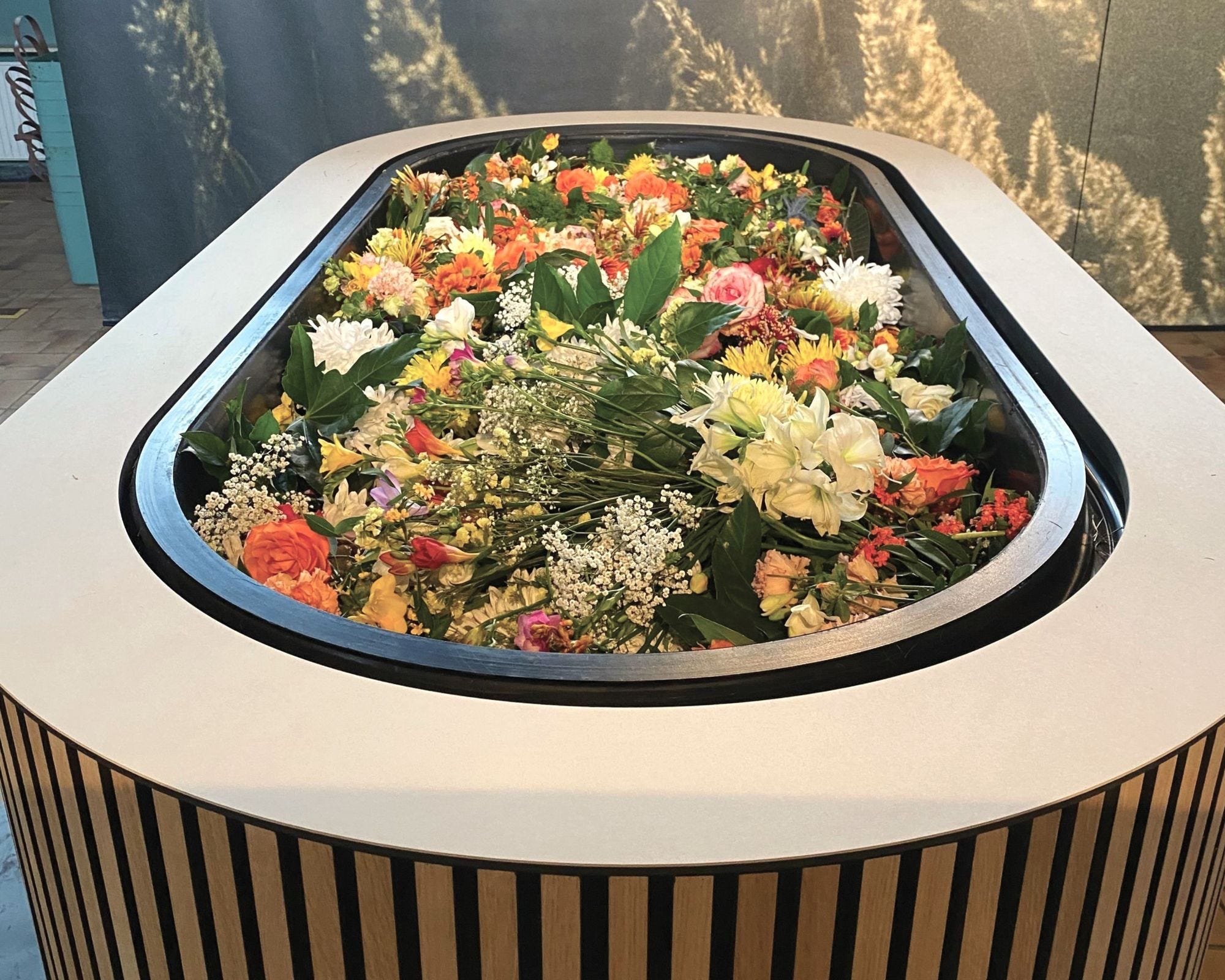
They can cry. They can tell the stories I would have wanted told, and the ones I would have hated. They can laugh. They can be angry. They can take their time. There is no furnace waiting.
Then my body can continue its transformation.
Forty days.
The Tibetan Book of the Dead calls the interval between death and what comes next the bardo, or the in-between. My body would be in its own bardo: not yet soil, no longer flesh.
At the end of it, I would become part of a landscape. Perhaps what the trees are drinking. Perhaps wildflowers. Perhaps the roots beneath a path. Perhaps the soil nourishing birds and foxes and all the strange forms of life that already thrive inside Green-Wood's gates.
Not interred. Dispersed. Which is different from a there.
For years, I thought I was trying to solve a logistical problem.
Burial or cremation. Ashes or water. A cemetery or something else.
I see now I was trying to answer a different question: Where does my body belong?
Not in a country. Not even in a grave.
In the roots beneath a path. In what foxes walk on.
And if Green-Wood's timeline holds, 2027 gives me something to aim for!
Thank you for being here. Today's essay is free for everyone. If it stays with you, consider sharing it with someone who might need it, or becoming a paid subscriber. A click of the ♡ helps too. Your support keeps this work alive.
I have been writing about death for a while now—my own, and what it asks of the living. Other essays in this conversation are linked below:


Holiday Shopping with a Twist: Picking Coffins and Reflecting on Legacies

Welcome to a journey that is mine, but also yours. A journey that belongs to all of us: the passage into life's final chapter. For the past two and a half years, I’ve been preparing—not just in the small, practical ways, but in the deep, tender ones: tending to the heart, readying the spirit.
Wonderful, in particular the musing that the boundaries we create are just that, created, a fiction. Big hugs & kisses
I've been following your journey, reading your notes and postings across social media platforms, every single one of your posts. You are amazing, unrelenting inspiration, strong, and powerful. I admire you and I have learned so much from you over the years. I'm grateful to the universe for connecting us. The world needs to hear you because you've touched so many people.