
Dear Liver
What I swallowed, what it carried, and the organ still carrying me

Every reflexologist finds it. I never tell them the diagnosis. Every time, somewhere in the middle of my right foot, the thumb stops. Presses again.
“You have some congestion here”, one says.
“I’m getting a strong response here,” says another, pressing the point again before looking up at me.
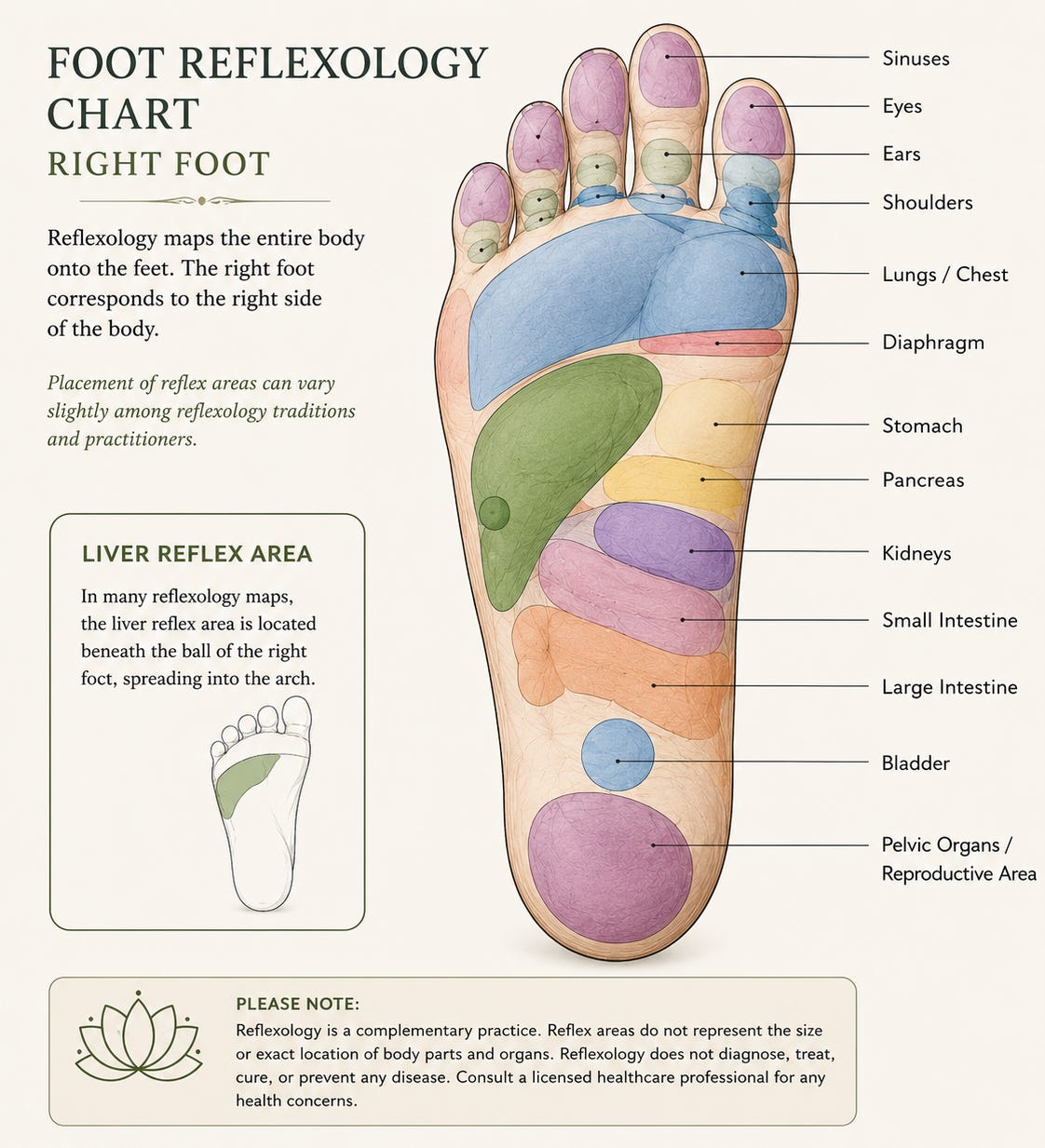
On the map of the sole, the liver is a broad territory beneath the ball of the right foot, extending into the arch. Mine announces itself to strangers.
In traditional Chinese medicine, the liver is associated with anger.
One of my acupuncturists is in Chinatown, working out of a gloriously disheveled office. He also seems to know what is wrong before I say anything. He needles for toxicity (chemo) and immunity (low blood counts) and sends me home to the deepest sleep I get all month.
He never asks what I am angry about. It is his job to know, and mine, apparently, to find out.
So I do what I have always done when a relationship is in trouble and the other party will not talk.
I write a letter.
Dear Liver,
I took you for granted for fifty years. You never complained. I have since learned that you are the only organ that can regrow yourself, which may explain your patience. Perhaps you always assumed you could repair whatever I sent your way.
I sent a lot.
I grew up on the rhythm of the monthly grocery run. Load the cart high. Eat the cupboards bare. Wait. I carried that rhythm into adulthood and called it discipline.
I sent you decades of diet soda and red wine. What I did to make this body acceptable, I will not itemize here. You were there. I starved you and flooded you and never once wondered how you were doing with any of it.
The food was the least of it. You got Rwanda. I was twenty-five, interviewing survivors of a genocide, and I had nowhere to put what they told me. So I swallowed it.
You got Geneva: dissidents at my dinner table who had survived their own governments, days drafting careful sentences about what had been done to them, and the slow education that the institutions charged with holding countries to human rights standards did not always live by those standards themselves.
You got the Security Council, and a seat on its Panel of Experts, which sounded like an honor and lived like a siege. I woke every morning already braced for a fight I had been rehearsing in my sleep. I was the only woman. Whole sections of my reports disappeared on “technicalities.” I defended my competence again and again and then my integrity.
I called it commitment and sent it down to you as cortisol.
Now, having sent you poison in small installments for decades, I send it in bags.
Gemcitabine ran so hot that it burned my veins. The nurses wrapped warm packs around my arm while the drug went in. Eventually I got a port and spared the smaller roads, building a highway straight into my chest.
Cisplatin. Oxaliplatin. Then medications to manage the medications.
A biopsy needle, which you resented. You registered your objection with a high fever that lasted for days.
And through all of it you carried the things neither of us chose: the tumors, the shadows on every scan. I watch the radiologists measure them and wait for the numbers to tell me what kind of future I am allowed to imagine.
Dear Liver, what are your secrets? What am I still here to learn?
The liver, being a liver, took its time to respond. The reply came in pieces, over years, through translators.
The first translator worked in Italian. Anna, an intuitive healer I consulted over video, knew nothing of my history. She told me that the trouble in my liver was older than I was. It belonged, she said, to the women in my family: women who traded their worth for safety, who bit their tongues for security, who endured humiliation as the price of being provided for.
She said that the humiliations I had absorbed at the UN were the same bargain in modern dress.
The second translator worked in Peru, in a maloca, a ceremonial roundhouse open to the night. I sat on a thin mattress on the floor while the jungle sounded around us, and the curandero sang icaros—healing songs, in Shipibo—addressed to each of us in turn. He knew things about me that no one had told him. I understood nothing of what he sang. A friend who speaks Shipibo translated afterward. It came down to two words: worry and fear.
That is what feeds the cancer, he said.
Not what I had swallowed thirty years ago. What I was still swallowing. Every day.
What came next arrived through a medium, in my father's voice. I have let most of it go. What stayed was one sentence: "What is happening in your liver is what you inherited from me."
I do not ask you to believe in mediums. I am not always sure what I believe myself. But when I heard those words, I felt them in my body before I had time to decide what I thought.
My father was brilliant and angry and had no idea what to do with either. His moods arrived before he did. You could read the evening in the way he came up the stairs, and dinner was one place where he argued them out.
The whole house adjusted around him without ever saying so.
I was the middle child, the go-between, the negotiator, the one who scanned every room to see who was angry at whom so I would know where to position myself. When the family split between two cars, I always volunteered to ride with him, not because I wanted to, but so he would not have to see that no one did.
It was my first job: absorbing something painful before it could reach the person it belonged to. Anna had said the trouble came down through the women. She didn't know it came down to a passenger seat.
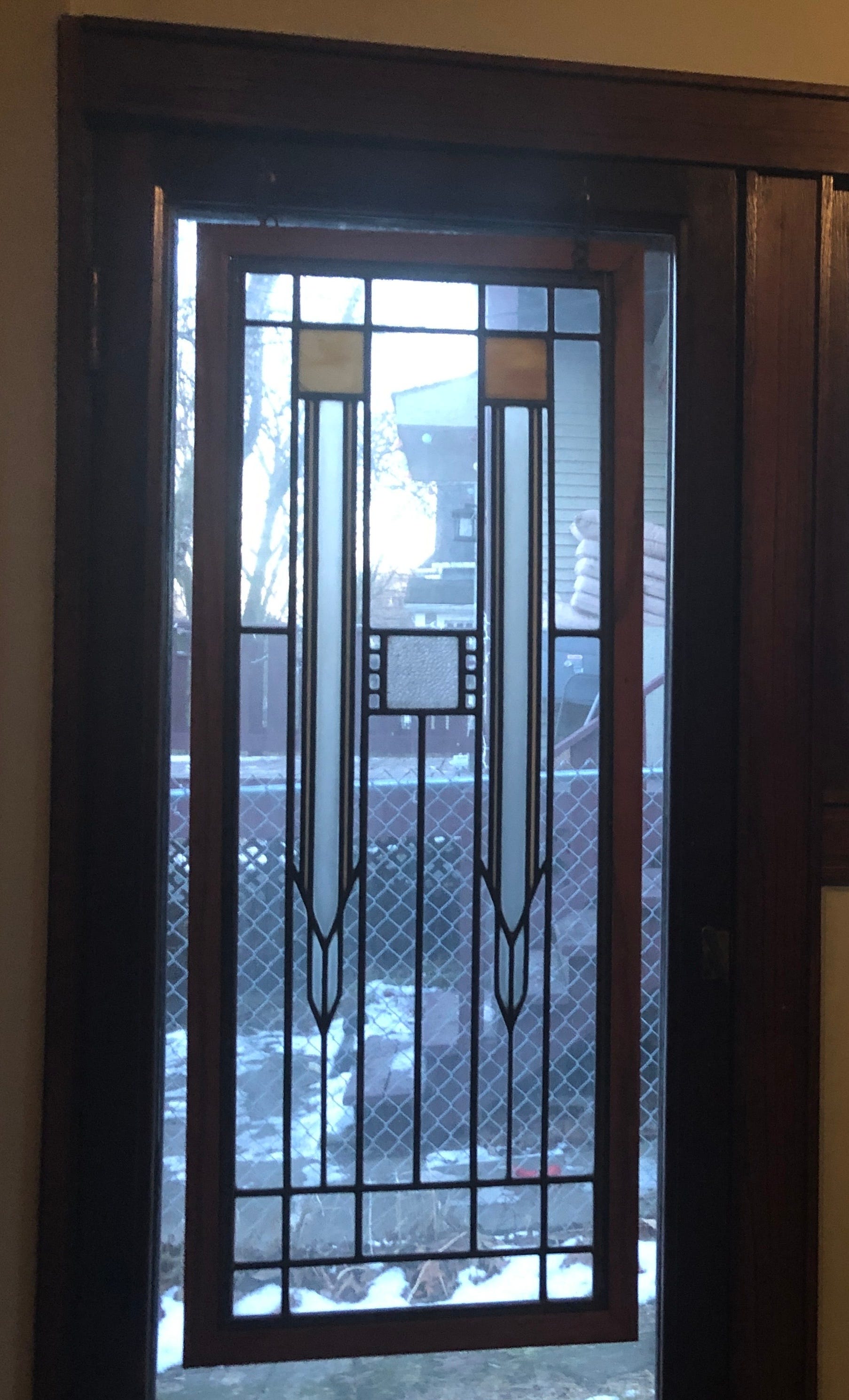
What my father could not say, he built: furniture refinished, additions finished by his own hands over years, stained-glass panels set into ordinary windows. Art disguised as improvements to the house. And he loved opera more than almost anything: the one place people are allowed to be as loud as what they feel.
He is the one ancestor I never needed a healer to locate inside me. I got his anger. But I also got the job of swallowing it before anyone could see. His fire, and the family instruction to keep it indoors. It took me years to notice those two inheritances were incompatible, and to wonder whether my liver was where they had been fighting it out.
Later, a bodyworker told me the liver likes to be loud, almost as if she had known him. Its energy moves up and out, she said. It wants guttural sound. Growling. Yelling into pillows.
She could not have known I had already done it. A month of mornings, a few years into the illness, when I finally gave Rwanda room to breathe and what surfaced came out in sound: grief, fury, sorrow, my face pressed into a pillow so the neighbors would not worry.
I thought of every meeting in which I had made my case in careful sentences while the fury waited below my diaphragm in business attire.
I had spent thirty years putting anger into language that other people could tolerate. I had been running a wilderness through a diplomatic pouch.
And then in Sedona, when I asked a Chinese tarot reader a question about my health, she pulled the ten of swords: a figure face down, ten blades in the back, and, in the corner of the card, a sun coming up on a calm sea. She began to try to talk around it. I named the card. She went quiet.
By then, I was doing the translating myself.
Assembled, the Liver’s reply read something like this:
Dear Stephanie,
You keep trying to make this about food.
The food matters. But it is not the whole story.
I am not telling you why you got sick. I am telling you what it was like to carry you.
I know what to do with chemicals. I have been doing it all your life. What exhausted me was everything you refused to put anywhere else: fear, rage, grief, other people’s stories and your own. Some of it arrived with you. Some of it was not even yours to begin with.
You called much of it work. I still had to carry it.
You keep asking what you did wrong. I would rather you notice what I have managed to do, and what we managed to do, together.
When the doctors went in to place a stent, they found my bile ducts still open and draining around tumors that should have crushed them shut. Where the portal vein was compressed, I had grown new capillaries. Small detours around the blockage.
Your doctors were surprised enough to call other doctors into the room.
You went home a day early and privately wondered whether the shower ritual of the “river of light” had helped: the one in which you imagined the water carrying the toxins away.
Perhaps it did. You were not the only one trying.
I do not need your guilt. From down here it is just more anger and I am the one who carries it.
I need you to help me now.
Say the prayer before you eat. Ask the food to be kind to me, and mean it. The old man in the sweat lodge told you this.
Make the ugly sounds.
And please stop asking me to metabolize the future before it happens. We have enough to deal with today.
You spent your career watching institutions exhaust the people who kept them alive. You did not notice for a long time that you were asking the same thing of me.
We are on speaking terms now. We no longer need letters.
I still send the bags of poison, with every treatment cycle. There is no way around that part.
But I have stopped apologizing for it. The liver, of all organs, understands that sometimes the work is brutal and the materials are imperfect.
I say a small prayer over my meals now. I felt self-conscious at first, much as I did the first time I bowed in a temple. Less so now. Some days I forget the prayer entirely and remember it only when the plate is empty.
Other mornings, alone in the apartment, I hum, moan and let my voice do whatever it wants, no pillow now. A sound with no policy objective.
Sometimes, beneath my right ribs, something I cannot prove settles.
The anger is not gone. I checked. I do not think it is the sort of thing that goes. The world restocks it daily. The wars now burning are in places I once worked. The emergency I spent my life flying toward no longer requires the flight.
Some mornings the enormity paralyzes me: one sick woman staring at the news, wondering where her remaining energy belongs. I do what is in front of me— the boards I serve, the people I coach, the patients I walk beside, my writing—and it never feels equal to what is wrong. It did not feel equal at twenty-five in Rwanda either.
But I am trying to give my anger somewhere else to live. I am trying to let it out before I turn it into a memorandum or another burden for my liver to carry.
Last month, a new reflexologist pressed the arch of my right foot and paused, the way they all pause.
“There’s something here”, she said carefully.
I know, I told her. We’re in touch.
Hi Steph, I rarely comment but I read everything you write. Your writing, your thoughts, your musings, your honesty continue to inspire me, push me to grow and give me new ideas and things to consider. I love you! Thank you for sharing your journey with so many of us. It's such a gift.
Your pieces always make me weep. They make me feel a recognition and a resonance of experiences and places I have set aside. I think that is probably a good thing for my heart, my soul and my liver. Thank you for writing and sharing.